
Q1: Looking back at your final project, what made it stand out as a “unicorn” rather than just a well-executed event?
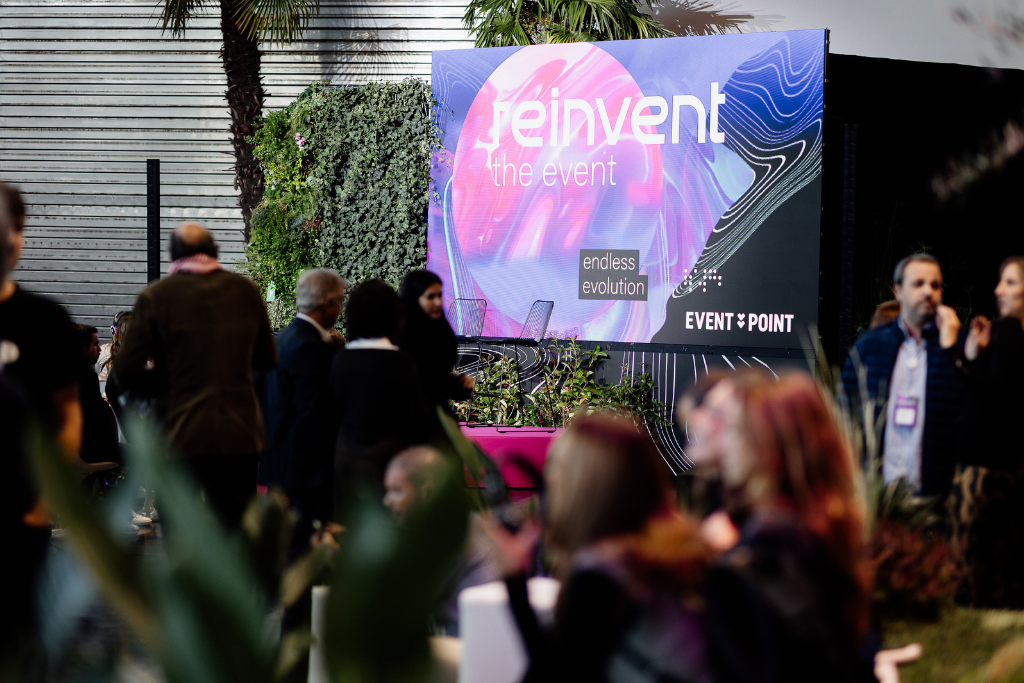
REINVENT the Event, which won in the B2B category at the Revolution Awards, was the first event dedicated to the events industry to be held in a fully in-person format. The goal was to create an entire day dedicated to people working in the events industry. What was initially planned as a simple conference for around 300 people in an auditorium quickly evolved into a large-scale event, with over 900 registrations and around 700 attendees in the main auditorium. It included parallel sessions using silent room systems, partner pitches, a large exhibition area, and an awards ceremony recognising key industry personalities.
More than just an event, we also created the “Eventeers Awards” to celebrate individuals who stood out across six categories: New Talent, Technology, Art, Craft, Inspiration, and the Event Point Editorial Award. In our industry, the focus is usually on showcasing events. What made this project different was that it celebrated the people behind the events, those who create and produce them. This event was designed in detail for event professionals, which meant a very high level of rigour in every aspect: from speaker panels and the involvement of industry clients, to catering, exhibition activations, and access to highly valuable content, all offered completely free of charge.
It was an event executed without the client’s budget support. It was fully supported by our partners and suppliers, those who work alongside us every day, by Turismo de Portugal and Turismo de Cascais, and by the full commitment of the entire iMotion Events team. That is what made the difference and ultimately secured this award.
Q2: If you had to define one shift in the events industry between 2023 and 2026, what has fundamentally changed?
Between 2023 and 2026, the most significant shift in the events industry has been the emergence of a new balance among physical presence, technology, and client expectations.
In the immediate post-COVID period, especially in 2023, we saw a rapid return to in-person events. After two years dominated by digital formats and remote work, there was a strong need to reconnect in person. At the same time, this return came with a clear digital influence: clients, used to tools such as augmented reality, virtual environments, and green-screen production, began to expect more technology integrated into live events.
At first, many events adopted a hybrid format. But it quickly became clear that this meant producing two separate events: one physical and one digital, each with its own content, dynamics and requirements. This level of investment proved unsustainable, and the industry naturally moved back to mostly in-person events, keeping streaming as an extension when needed.
The real shift wasn’t just the return to live events; it was the move towards a more agile, more technologically prepared industry.
Over the past two years, the evolution of artificial intelligence has introduced new tools that are transforming how we think, create and produce events. Today, we are faster, more efficient and better equipped. The real shift wasn’t just the return to live events; it was the move towards a more agile, more technologically prepared industry, and above all, one that is far more demanding creatively. Clients today expect more than execution; they expect differentiation, strong concepts, clear storytelling and truly memorable experiences. And that’s exactly what we aim to deliver today.
Q3: The competition is evolving into the Unicorn Awards. How would you define a “unicorn event”?
At iMotion Events, our Head of Creativity, João Pereira, often says that every proposal needs to have a “Pinocchio’s nose.” Why? Because without that unique feature, Pinocchio would just be a wooden puppet. And that’s exactly what happens with many events: they are good, well executed, but they lack that one detail that makes them truly memorable.
A “unicorn event” is exactly that. It’s not about execution, it’s about impact. It’s that moment, that idea, that unexpected twist that changes everything. That “Pinocchio’s nose” doesn’t come from having a bigger budget or more technology (although it can help!). It comes from making tough decisions: cutting what’s obvious, challenging the client, and daring to build a narrative that isn’t always the most comfortable one. Very often, it comes from saying “no” to what feels safe.
Today, with so much happening at once, a unicorn event can’t please everyone, but it becomes unforgettable for the people who truly matter. And that’s exactly what we look for every day: finding that defining detail, working together across creativity, 2D and 3D design, copy, storytelling and project management, to make sure every event is not just well executed, but has its own “Pinocchio’s nose.”
Q4: Do you think the industry is becoming more focused on impact or spectacle, and where do you stand?
I think the industry isn’t focused solely on impact or solely on spectacle; it’s inevitably focused on both. And that’s a good thing, because one doesn’t exclude the other.
We believe that impact and spectacle can (and should!) work together, depending on the type of event. In a more corporate and formal context, what really matters is the message’s impact, relevance, and staying power with the audience. You don’t need a spectacle to achieve that.
In other formats, like a Christmas Party, spectacle is part of the expectation, and it’s precisely through that spectacle that impact is created. So, it doesn’t make sense to separate the two. But if I had to choose, impact always comes first, with or without spectacle!
Q5: What is the most underestimated challenge in delivering outstanding events today?
Today, the most underestimated challenge is, without a doubt, time… and budget.
To create truly differentiated events, we need time. Time to think, to create, to test ideas, even to fail. And the reality is that this time is becoming increasingly limited. We want to do better, but we have less space for the creative process to happen properly.
Then there’s the budget, which remains a critical issue. Often, there’s no clear framework, forcing us to work in the abstract to “deliver the dream” without really knowing what resources we have. And even when a budget exists, it’s not always aligned with the project’s ambition.
In the end, the biggest challenge today is not a lack of ideas; it’s having the right conditions to turn them into something truly exceptional, often with very limited budgets.
Today, a proposal rarely gets approved the first time; it requires adjustments, refinements, and multiple iterations. That means re-engaging teams, revisiting concepts, and adapting everything, often under already very tight timelines. This has a direct impact on our internal planning, as we are managing proposals that are not yet confirmed while simultaneously delivering projects that are already secured. In the end, the biggest challenge today is not a lack of ideas; it’s having the right conditions to turn them into something truly exceptional, often with very limited budgets.
Q6: Where do you see the biggest gap between what clients want and what events actually deliver?
The biggest gap often lies between ambition and the real conditions needed to turn a strong proposal into a great, or truly exceptional, event. In fact, this question is very closely related to the previous one.
Clients rightly want more and more: differentiated events, with impact, creativity and memorable experiences. But that ambition doesn’t always come with the time, budget and clarity needed to bring it to life exactly as planned.
We have a Portuguese saying: “you can’t do something quickly and perfectly at the same time”.
There is also a growing expectation for speed and constant adaptation, which often conflicts with the time required to build solid, well-executed ideas. Today, everything moves very fast. We have a Portuguese saying: “you can’t do something quickly and perfectly at the same time”, and that really reflects our reality. The real challenge is aligning ambition with the right conditions to make it happen. And that’s where the biggest gap is today.
Q7: Is there a recent project or idea you are particularly proud of, and why?
Yes! I would say that one of the recent projects we are most proud of was a Christmas Party we delivered at the end of 2025 for around 4,000 people, for a client in the consulting sector. This project also earned us a Silver award at the Heavent Awards in Cannes.
It’s a client that challenges us every year. There is always strong competition, so winning this project is already a significant achievement, but winning an award with it makes it even more special. It’s also an event with very high expectations from the audience, precisely because each year it brings a strong concept. To win it, we had to be truly disruptive, creative, and build a narrative and storytelling that clearly showed the client we were on the right path.
We created a fully immersive experience, carefully designed from the moment guests entered the venue. Everything was connected: animations, activations, and AI-driven content, across 7 uninterrupted hours of entertainment. We developed a fully virtual DJ experience, and the entire space was transformed so that, as people walked in, they almost didn’t recognise it. More than just a Christmas party, it was a collective experience, designed to engage emotionally and reflect the client’s culture.
Q8: What do you believe will shape the future of events?
People. People are, without a doubt, what will shape the future of events. Without people, there are no truly emotional events, the kind where you feel something, where your heart beats faster, where you get goosebumps as you enter a venue. It’s this human dimension that brings events to life and turns an idea into reality. People are the ones who think, create and produce, but they are also the ones who experience the event, react, feel, and give meaning to everything that has been designed.
Technology and artificial intelligence will continue to evolve and help us do more and do better, to be more efficient, more creative, faster. They will play an increasingly important role. But they will never be the focus or the core of events.
The future of events will be shaped by those who can find this balance: using all available tools without losing sight of what truly matters, creating experiences that make people feel, build connections, and stay in people’s memories. Because in the end, without people bringing emotion and life to what has been created, an event simply does not exist.
Explore more about iMotion Events here.