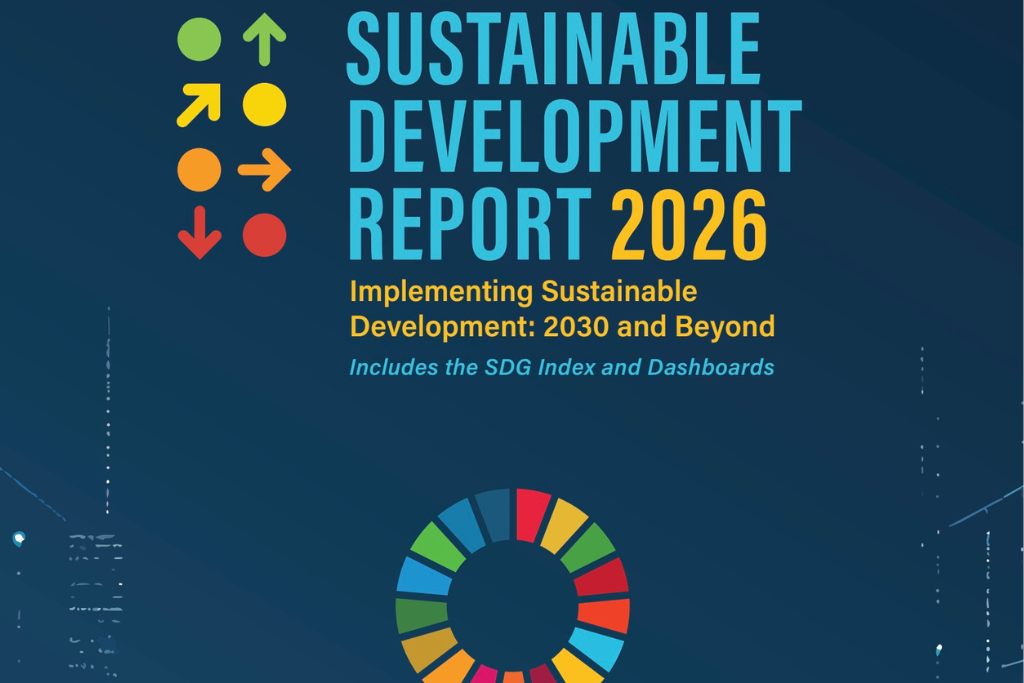
This year’s SDR highlights the following key findings:
1. Global commitment to the SDGs remains strong. A large majority of countries continue to support UN General Assembly (UNGA) resolutions referencing sustainable development, with more than 170 of the 193 UN Member States backing all of these resolutions in 2025. Argentina and the United States were the only countries to consistently vote against resolutions linked to the sustainable development framework.
2. East and South Asia outperform all other regions on SDG progress. East and South Asian countries have recorded the strongest SDG progress since 2015. Among major economies, India (+18) and China (+14) show the largest rank improvements. Finland leads this year’s SDG Index, followed by Sweden and Denmark. However, even these top performers face significant challenges on SDG 12 (Responsible Consumption and Production), SDG 13 (Climate Action), SDG 14 (Life Below Water), and SDG 15 (Life on Land), partly due to unsustainable consumption patterns and negative international spillover effects.
3. Goals related to cities, the environment, sustainable agri-food systems, and peace are particularly off-track. Among these, the most concerning are SDG 11 (Sustainable Cities and Communities), SDG 14 (Life Below Water), SDG 15 (Life on Land), and SDG 16 (Peace, Justice, and Strong Institutions). At the indicator level, the areas furthest from their targets include progress toward sustainable agriculture (SDG 2), the prevalence of obesity (SDG 3), as well as the timeliness of administrative proceedings, press freedom, and the Corruption Perceptions Index (SDG 16). In contrast, several indicators are progressing at the global level. These include rising mobile broadband subscriptions and internet use (SDG 9), declining adolescent fertility rates and HIV infections (SDG 3), and expanded electricity access (SDG 7).
4. Barbados ranks first in commitment to UN-based multilateralism, while the U.S. ranks last. Barbados ranks as the country most committed to UN-based multilateralism in the SDR’s 2026 Index of Countries’ Support to UN-based Multilateralism (UN-Mi), which assesses countries’ engagement with the UN system and their support for SDG 17 (Partnerships for the Goals) using six headline indicators. At the opposite end of the Index, the U.S. ranks last. This is highlighted in recent actions from the U.S. federal government, which withdrew from more than 60 international organizations in January 2026; voted with the international majority in only 5% of recorded UNGA votes in 2025; and formally opposes the SDGs, the 2030 Agenda, and the Paris Climate Agreement.
5. Strengthening implementation is the defining priority for the next era of sustainable development. In 2026, the SDSN surveyed its networks across 64 countries and the European Union, alongside over 1,000 respondents from 127 countries, to assess government efforts and barriers to SDG implementation. Respondents broadly support maintaining the SDG framework beyond 2030, pointing to financing, governance, and the use of science and data as the areas most in need of strengthening. Views on progress vary significantly by region, with East and South Asia reporting more optimistic assessments of national and local SDG performance.
6. Eight priorities for the next decades of sustainable development. The report identifies eight priorities to accelerate progress toward 2030 and beyond: (1) end ongoing wars and redirect military expenditures toward peace and human development; (2) establish an ambitious timeline for SDG implementation; (3) organize implementation around six major transformations; (4) adopt long-term investment plans to support these transformations; (5) strengthen continental, regional, and local cooperation and investment; (6) introduce new global taxes to finance global public goods; (7) develop global governance frameworks for AI, biotechnology, and other emerging technologies; and (8) establish new UN campuses in Asia, Africa, and Latin America.
Find out more here.


 Loading...