


In his new white paper, The CAT and Perfect Strangers, meeting design pioneer Maarten Vanneste contends that conferences often overlook their most valuable asset: the collective knowledge, experience, and relational potential of attendees. He introduces CAT, a structured approach designed to transform this resource into clearer learning, stronger engagement, and greater participant value.
Modern conferences rely on sophisticated infrastructure, including speakers, audiovisual production, digital platforms, catering, and curated content. However, Vanneste’s whitepaper notes that nearly every element can be simplified or replaced except the participants. They are essential, as only they can turn session content into action, organisational impact, and measurable return on investment. CAT aims to make this transformation intentional by engaging participants as active contributors rather than passive attendees.
Perfect Strangers challenges the events industry to rethink the traditional hierarchy of conference design. Instead of viewing delegates as passive recipients, Vanneste positions them as the main source of value. He proposes CAT (Conversations About the Topic), a structured method that alternates brief presentations with small group discussions. While simple to implement, this approach makes learning participatory, networking intentional, and engagement more measurable and valuable.
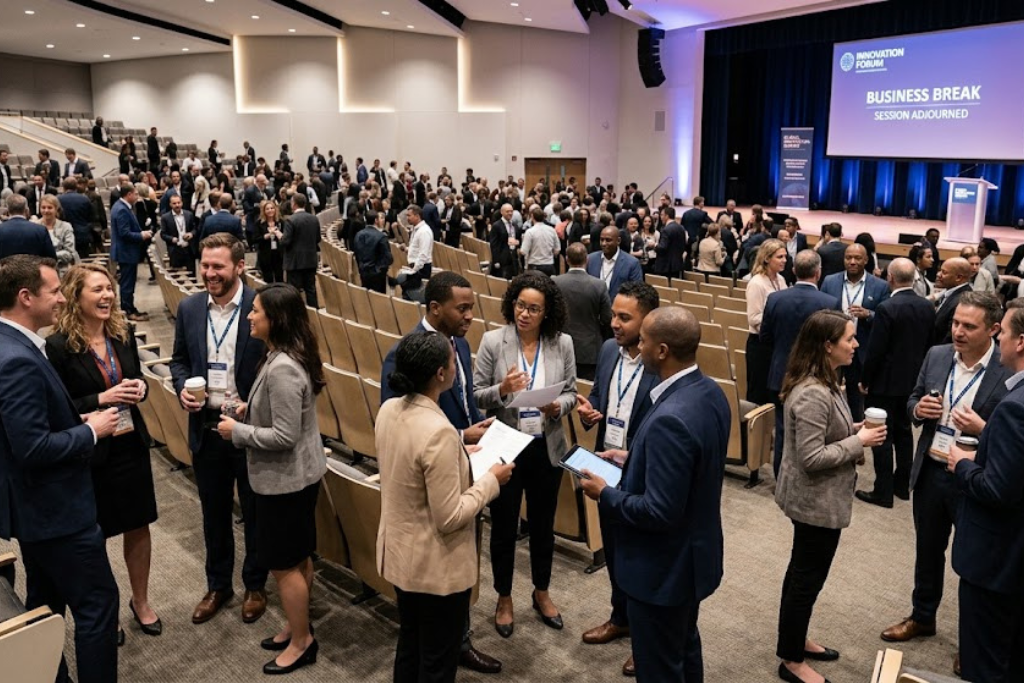
People often expect informal networking to make up for the limits of traditional formats, but coffee breaks and receptions rarely give everyone the same chance to connect. Most delegates stick with people they already know or feel comfortable with. Conversations with strangers are usually too short and random to find out if there’s a good fit or shared interests. Vanneste doubts that relying on chance meetings is enough, especially when people have invested time and money to attend. CAT gives these meetings more structure, making it more likely that strangers become useful contacts.
This leads to the whitepaper’s central question. If content can be consumed asynchronously through recordings, articles, books and webinars, what justifies convening hundreds of professionals in one place?
Vanneste locates the answer in the people whom participants would otherwise be unlikely to meet. He calls them “perfect strangers”: individuals who remain personally unknown to one another, but who have already been filtered by profession, sector and interest. Attendance at a particular session refines that selection further, bringing together people with an immediate topical affinity and making CAT especially effective.
A conversation architecture for conferences
CAT seeks to convert this temporary concentration of relevant people into substantive participant value. In the standard format proposed by Vanneste, ten minutes of presentation are followed by ten minutes of conversation in groups of no more than five. The sequence is repeated three times during a one-hour session. The expert contribution is not displaced, but divided into more digestible segments and used as the intellectual material for peer interpretation. This structure helps participants absorb content, apply it and leave with clearer takeaways.
 Loading...


The distinction is important. CAT is not simply an invitation to talk to the person sitting nearby. It is a deliberately timed and thematically bounded conversation among participants who share a reason for being in the room. Delegates can question an argument, compare it with their own experience and consider its practical application before the next segment begins. The technique consequently connects three dimensions that conference design often addresses separately: the acquisition of knowledge, the motivation generated through active contribution and the formation of new professional relationships. In doing so, CAT makes each dimension reinforce the others.
The potential networking effect is particularly striking. In a group of five, each participant can engage with four new people. Across ten sessions, an individual delegate could hold topic-focused conversations with 40 carefully filtered strangers. At an event for 500 participants, that would represent a maximum of 2,000 new connections per session and as many as 20,000 across the programme. These numbers describe potential rather than guaranteed relationships, yet they provide a useful counterpoint to the imprecise promise of spontaneous networking. They also show how CAT can expand meaningful connections at scale.
From an aspiration to a measurable standard
Perhaps the whitepaper’s most consequential proposal is to measure interaction through “CAT minutes per participant”. Vanneste suggests a benchmark of 24 minutes of structured conversation for every hour of presentation. This would make participant interaction visible within programme design and potentially establish it as a criterion for event approval, budget allocation and performance evaluation. It would also give CAT a clearer standard for demonstrating its practical value.
Perfect Strangers ultimately advances a broader critique of how conferences define value. Organisers have become highly proficient at designing platforms for speakers, but considerably less systematic in designing relationships among participants. Vanneste argues that this imbalance is no longer defensible. Every conference assembles a community that exists in that precise configuration only once. Allowing its members to remain largely anonymous to one another is not simply a missed networking opportunity. It is the underutilisation of the event’s most valuable intellectual and social capital. CAT offers a direct way to use that capital more fully.
Maarten Vanneste is an events industry leader and visionary with 30+ years of experience. Learn more about his Meeting Design Institute here.