
FIVE STARS IN ANY SEASON
LOCATION
THE HOTEL’S proximity to the lush forest and imposing Pirin Mountains sets it apart from the city’s hustle and bustle, giving it exclusivity and intimacy.
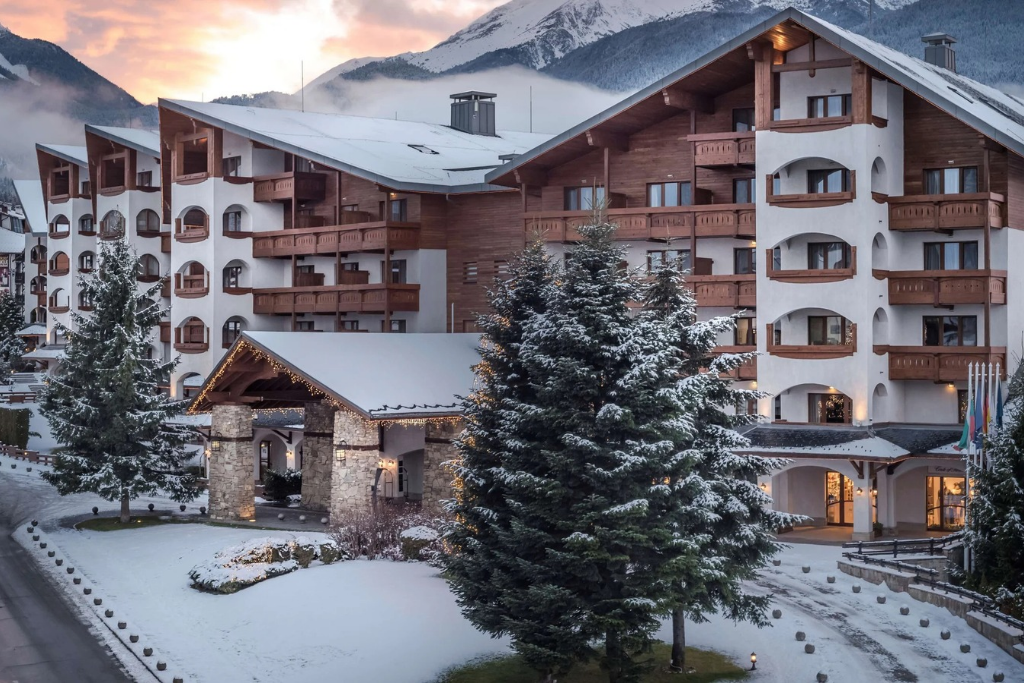
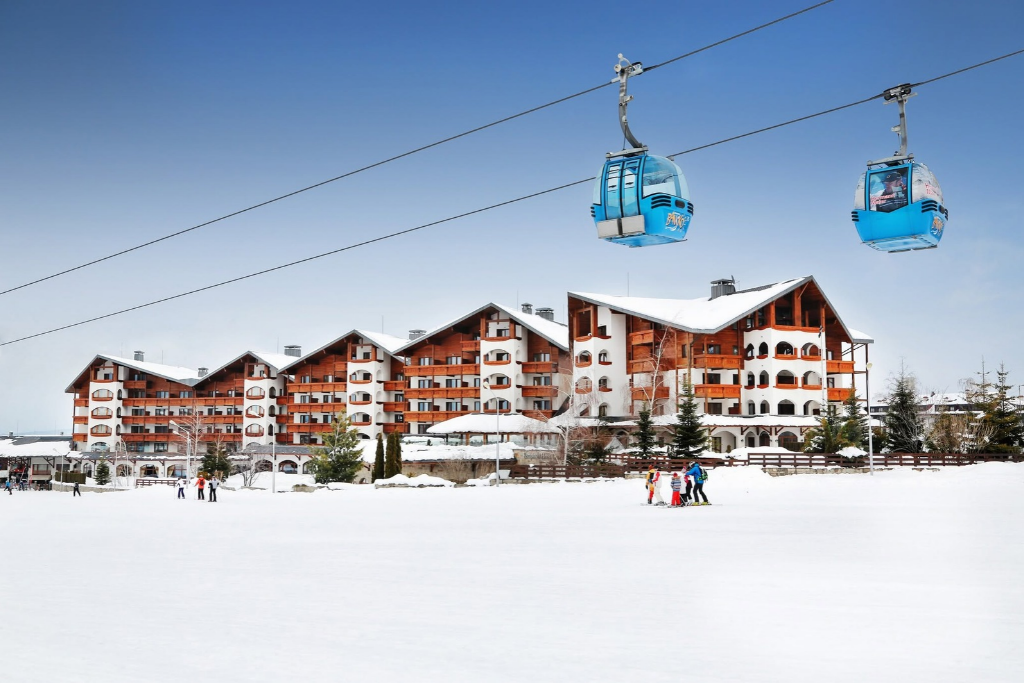
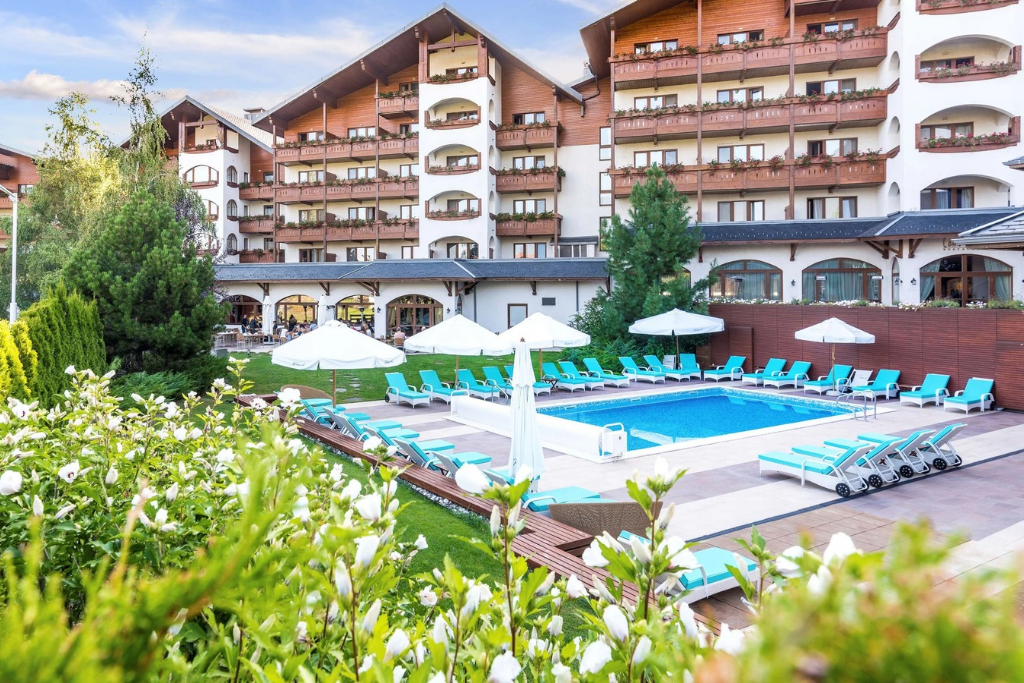
Nomen est omen; the name Grand Arena perfectly encapsulates the hotel’s favourable location at the foot of the Pirin Mountains, directly across from the lower gondola station. It’s hard to imagine a better location for a hotel in Bansko. In winter, access to over 75 kilometres of ski slopes is simple, while in summer, hiking trails, cycling paths, and mountain experiences are literally within arm’s reach. The city centre is only fifteen minutes away, making landmarks, restaurants, and lively resort happenings readily accessible. Nonetheless, the hotel exudes an aura of privacy and seclusion. Its proximity to the lush forest and imposing Pirin Mountains sets it apart from the city’s hustle and bustle, giving it exclusivity and intimacy. Its strategic position is undoubtedly a strength.
ACCESSIBILITY
The hotel handles accessibility admirably. Sofia Airport is 150 kilometres away, taking two to three hours depending on traffic, weather, and conditions on the last leg of the journey. Solun Airport is about 250 kilometres away and serves as a backup option for international groups. The hotel offers transfers by minibus or luxury vehicles, making the ride go by quickly. For a business event here, pre-arranged bus or shuttle transport is virtually obligatory. The narrow-gauge line and intercity buses suit individual private travel better than business groups that expect punctuality.
Getting here takes preparation, but continuing an event requires few extra transfers.
Once you arrive, though, the logistics are much simpler. The gondola, restaurants, bars, and the resort part of town are all within walking distance, and a slew of activities await at the hotel’s doorstep. Getting here takes preparation, but continuing an event requires few extra transfers.
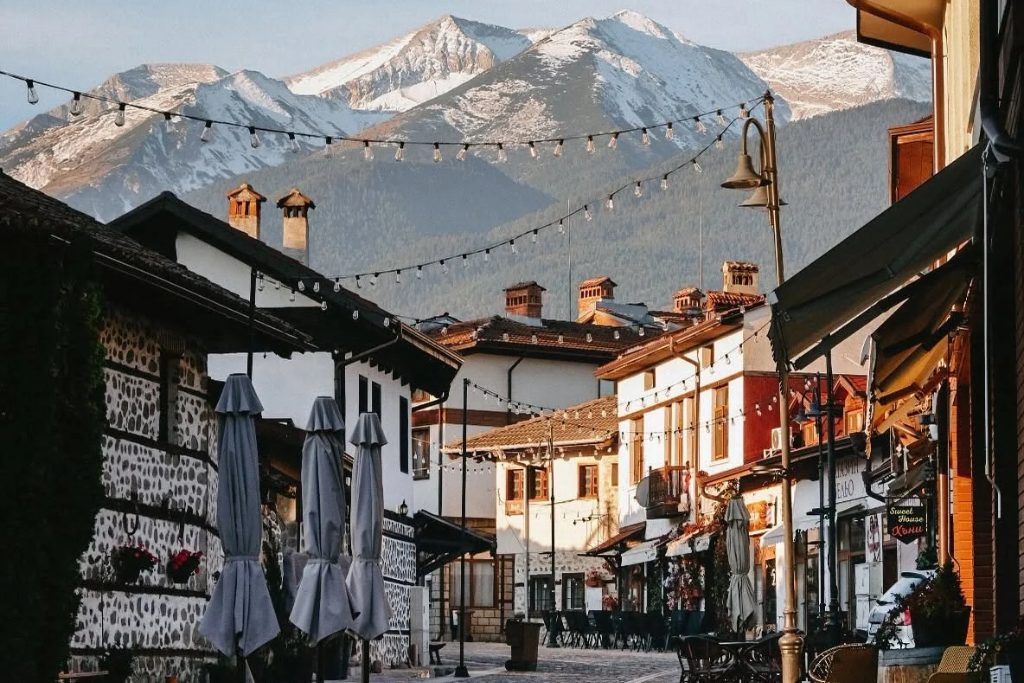
COLD STARTER - Architecture and aesthetics
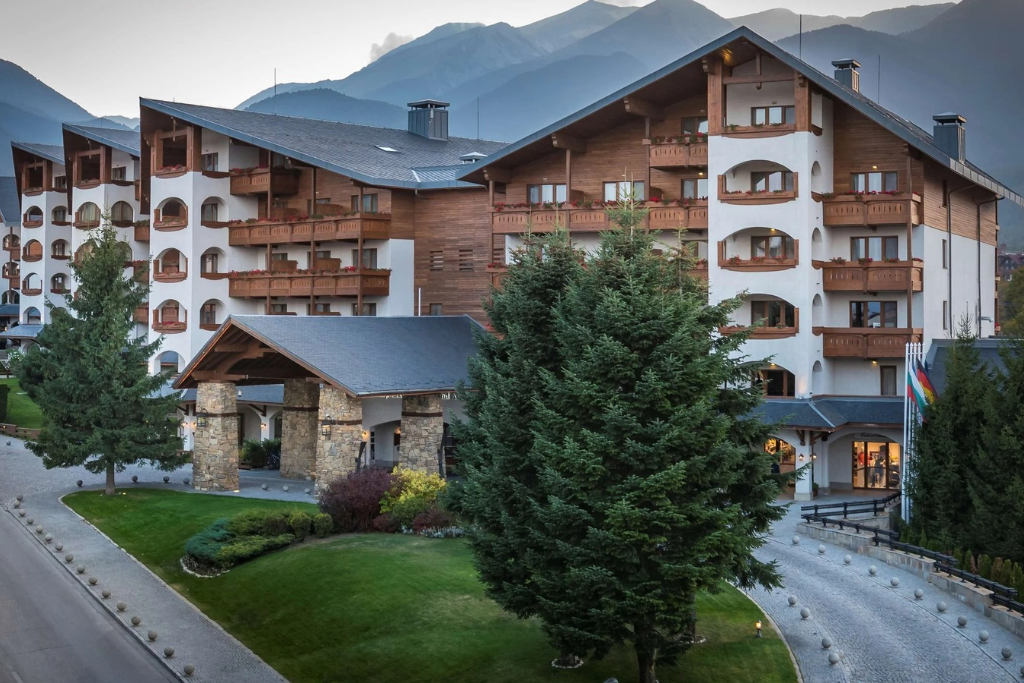
The hotel opened in 2005 and became one of the key facilities that transformed Bansko from a regional ski resort and put it on the international tourist map. The design uses the language of grand mountain resorts. An angled roof, stone and wood, broad balconies, and pavilion segments break up the massive main volume and give it a more human-centred feel. Though the exterior might not be avant-garde, it is proportionate, recognisable, and blends into the Pirin setting. The hotel does not compete with the mountain’s beauty; it lets nature do the talking. Interior choices are more questionable. Two decades after opening, some spaces inevitably feel more classic than modern. Gradual renovations, including those of the spa centre and Come Prima Restaurant, temporarily slow the ageing process, but do not change the traditional character of Kempinski elegance.
This is a beautiful, relatively compact mountain hotel that has aged gracefully while preserving its sense of prestige.
Guests seeking a refined European hotel will see this as an advantage. For event organisers seeking a particularly modern and designer-bold stage, this might be a limitation. Kempinski does not surprise with its architecture, but it convinces with excellent maintenance, quality materials, and harmony in the public corridors and spaces. It is a beautiful, relatively compact mountain hotel that has aged gracefully while preserving its sense of prestige.
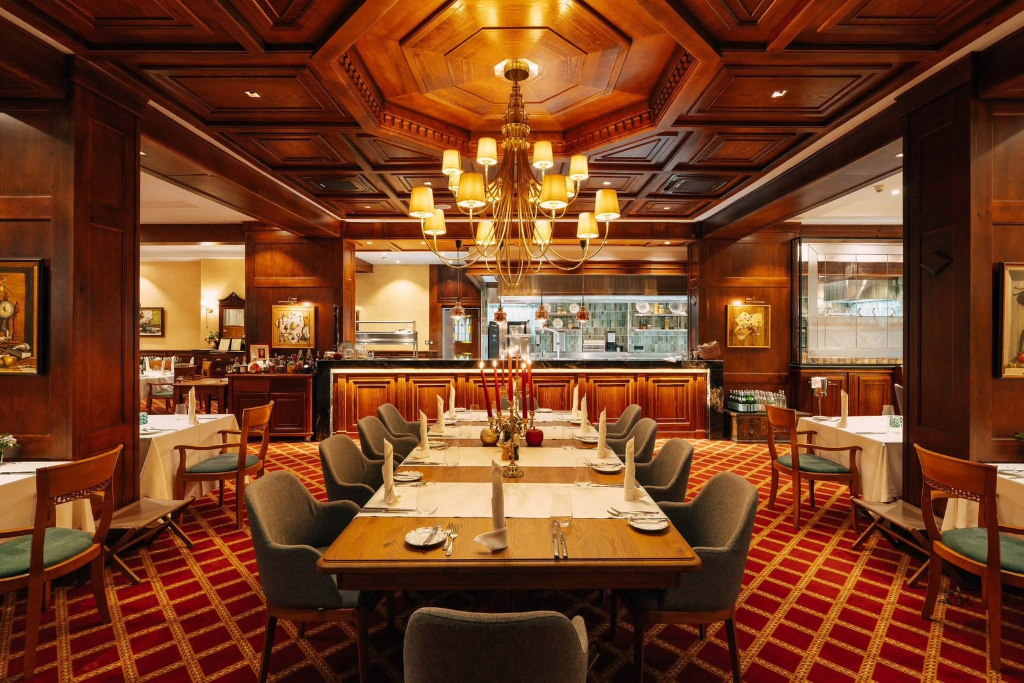
WARM ENTRÉE - The staff and the culinary experience
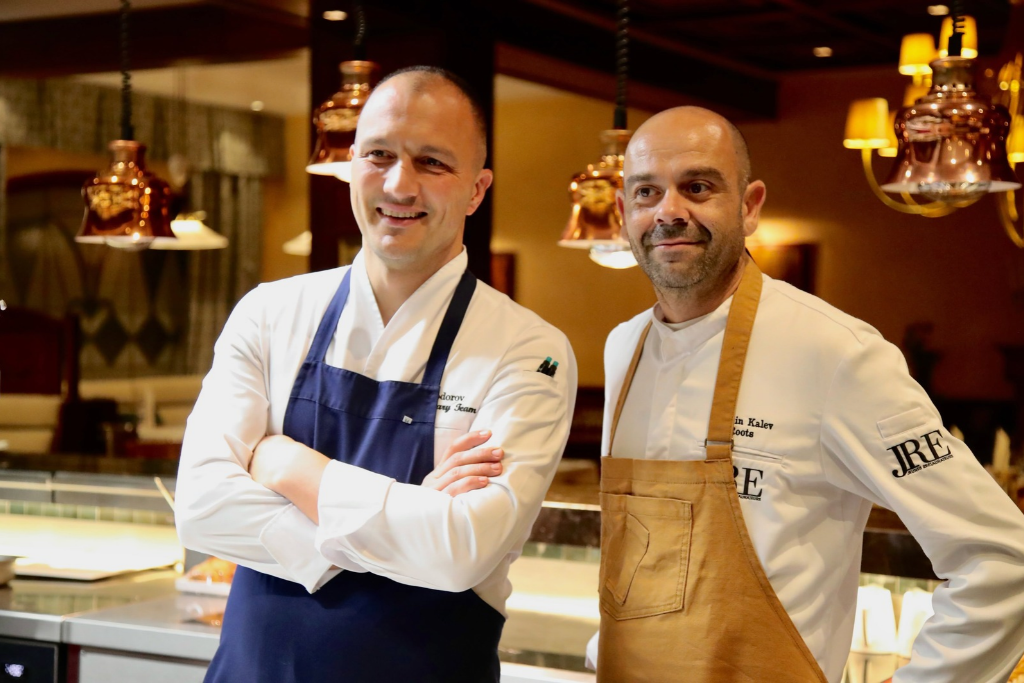
The resort’s culture of service and hospitality is one of its greatest advantages. In a hotel of this calibre, usual kindness and hospitality are not enough. What matters more is understanding needs, discretion, fast response, and making guests feel they are not just numbers. The personnel are adept at protocol; their approach is highly professional, and their communication is confident and effective. Service works like clockwork. This refinement also hides a minor drawback. At times, the service can feel formal and reserved. Although everything runs smoothly, it does not feel overtly organic or spontaneous. For a mountain resort, we would have expected more warmth, a relaxed approach, and authentic local character. Kempinski ensures high standards, but the best hotels also create an emotional connection with guests beyond the usual protocol. The gastronomy is broader and more ambitious than at other hotels in town. Gallery Restaurant focuses on breakfast and self-service dinner, while Come Prima focuses on Mediterranean fine dining. At the same time, Sushi Bar & Teppanyaki Grill adds Japanese flavours in winter. The Lobby Bar, Piano Bar Sing Sing, La Veranda, and Vitamin Bar offer a wide range of environments and ambience for informal meetings, private dinners, and closed parties. The only limitation is the seasonality of some bars.
The hotel has the knowledge and the infrastructure; it just needs more local bravery.
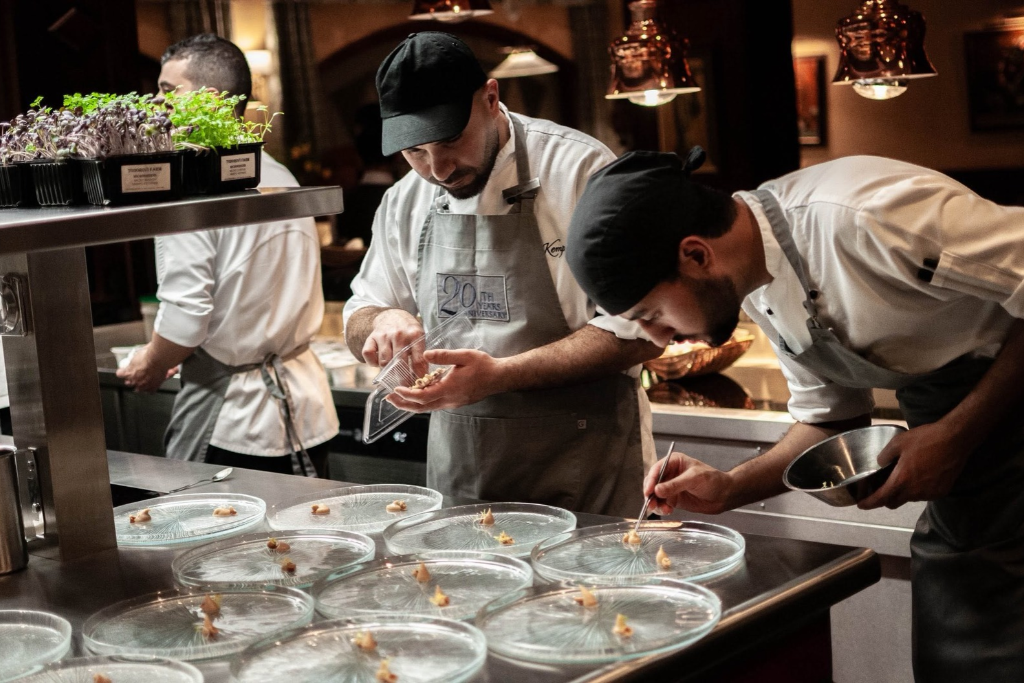
Breakfast is lavish, featuring over a hundred ingredients and dishes, cooking stations, local banitsa (traditional Bulgarian pie), smoked salmon and champagne. The selection is extraordinary; the execution is technically flawless, yet the quantity could be arranged more wisely. International hotel standards occasionally eclipse local flavours and dishes, leaving local suppliers out of the story. Kempinski understands that breakfast for a business group is the first event of the day and adapts it accordingly. The next step should be to reduce the profusion and feature more local content. Bansko, Bulgarian cuisine and its local suppliers deserve a more visible role. The hotel has the knowledge and the infrastructure; it just needs more local bravery.
MAIN COURSE – The meetings offering at the hotel
Hotel rooms
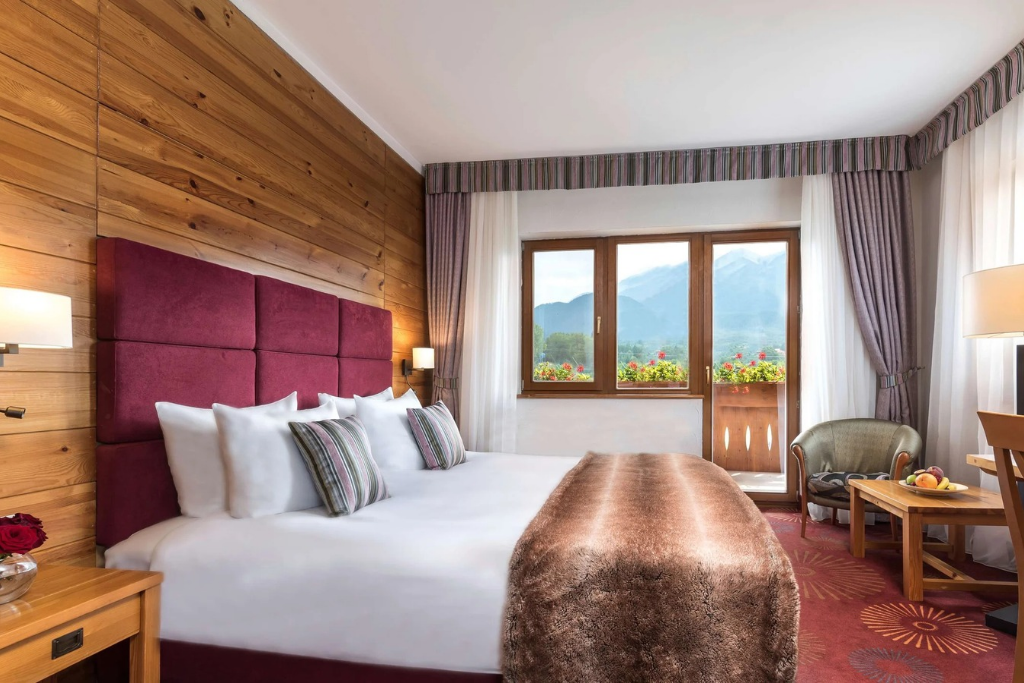
We stayed in the Executive Room, measuring some 40 square metres. The room is spacious, comfortable, and designed in a recognisable classic mountain-hotel style. Dark wood, brick-red textiles, heavy drapes, and soft carpets ooze a warm ambience, although the design language is more traditional than modern. An ultra-comfortable bed dominates the centre of the room, dressed in quality bed linen. Adjoining it are a console table, luggage rack and plenty of space to drop things off. The illumination enables various light variations. One of the room’s peculiarities is the separate living room in an arched space. The couch, lounger and club table are ideal for a short rest, savouring a morning coffee or an informal chat. Courtesy of the separation of the bedroom and living room, the entire space is perfect for longer stays for business guests.
Mountain views visually enlarge the room, fill it with daylight, and give you the feeling of a true mountain resort.
The room’s trump card is the balcony overlooking the Pirin Mountains. Equipped with a table and chairs, it feels like the natural extension of the room. Mountain views visually enlarge the room, fill it with daylight, and give you the feeling of a true mountain resort. Interior design alone cannot replicate this feeling. The bathroom is clad in bright stone and marble. A voluminous mirror, excellent lighting, a magnifying mirror, and plenty of space to put your things down ensure comfortable use. A bathtub with a glass barrier doubles as a shower. This solution is functional and impeccably maintained, yet less practical than a modern cabin with flat access. The bathroom equipment is slowly showing its age. Though the Executive Room is maintained gracefully and with dignity, it does not hide its age. Compared to other Bansko hotels, it is more conservative in design, but more convincing in spaciousness, comfort, material quality, and views. The room does not impress with designer freshness, but with a sense of peace, tried-and-tested luxury, and comfortable living.
Meetings centre
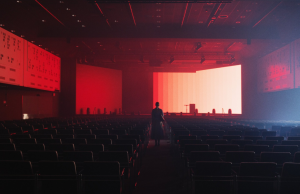
Kempinski offers four meeting rooms with a combined surface area of 431 square metres. The largest hall can accommodate up to 150 attendees, while the smaller rooms enable two or three parallel sessions. The halls are flooded with daylight and equipped with basic AV equipment, fast internet, and support from the hotel’s technicians. The congress space is functional and well suited to mid-sized business meetings, but it cannot be labelled a contemporary event centre. Low ceilings, classic decor, and the limited size of the plenary hall do not support demanding productions, large LED screens, or events with more than 150 attendees. The meeting centre’s greatest advantage is its adaptability, while its main shortcoming is the lack of designer and technological wow elements.
DESSERT – The extras
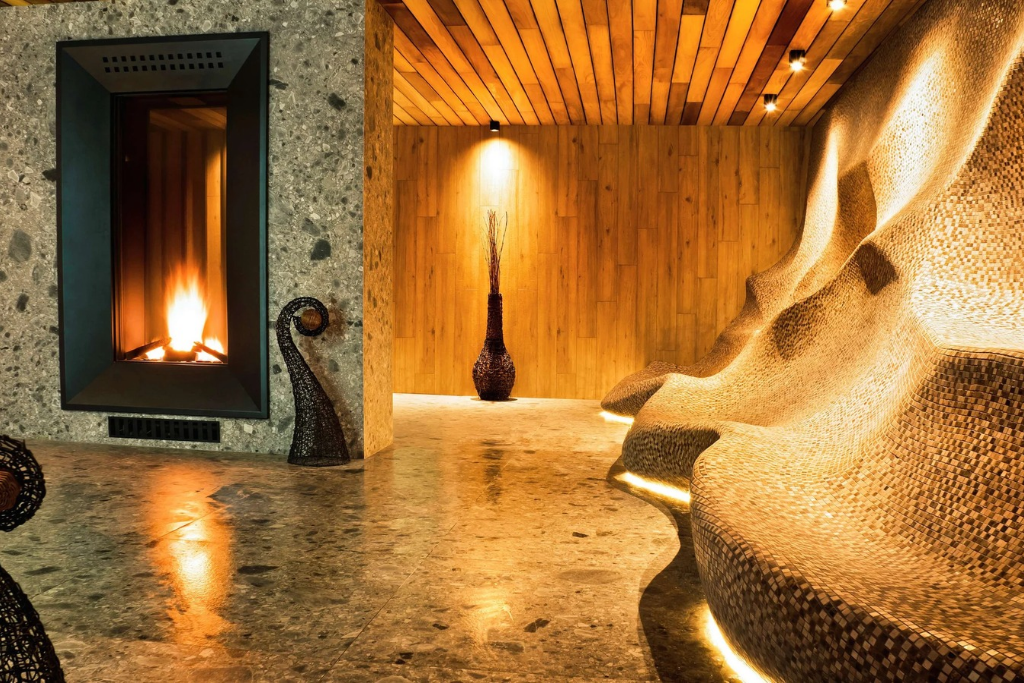
Kempinski The Spa is the hotel’s trump card. Covering a whopping 1,200 square metres, it offers a rich spa offering, including indoor and outdoor pools, whirlpools, a snow room, treatment rooms, and a gym. For incentive groups, it is not only a space for regeneration, but a useful part of the programme. In summer, the offering is enriched by hiking, cycling, tennis, and rafting, while in winter, the immediate vicinity of the gondola draws avid skiers and snowboarders. Far and few are regional resorts that so effectively intertwine work, activity and relaxation.
FLOP – NEGATIVE SURPRISES
The biggest drawback is not a lack of infrastructure, but its age and limited ambition. Four meeting rooms are useful, but they do not make it a contemporary conference centre. Low ceilings, classic decor, and the limited size of the plenary hall constrain events that require a big stage, demanding scenography, or more than 150 attendees. The second compromise is the price. Kempinski is significantly more expensive than the local Four Points by Sheraton. That is why an event organiser must know why and when a group needs higher service and cuisine standards. If an event’s programme does not include the spa, restaurants, a location next to the gondola, or exquisite personal service, the price is not worth it. Luxury not included in the event narrative only means a more expensive hotel room.
TOP – POSITIVE SURPRISES
Kempinski Hotel Grand Arena Bansko’s greatest advantage is the maturity of the entire offering. The hotel not only sells rooms and halls, but curates the resort experience. Four meeting rooms let the programme be thoughtfully divided, and the various restaurants pulse with a nightly rhythm. On top of that, the spa ensures regeneration, while the gondola and Pirin Mountains await within arm’s reach.
Compared to Four Points by Sheraton Bansko, the organisers have more possibilities without needing to move the group from hotel to hotel. A plenary session, executive session, workshops, private dinner, and wellness can run in parallel without demanding logistics. This reliability is the best argument for paying a steeper price.
SUSTAINABLE ENDEAVOURS
Kempinski has a more structured sustainability story than most other mountain resorts. It uses EartCheck’s system, publishes its environmental and social policy and has a certificate valid until 8 December 2026. The in-house green team ensures energy and water are used wisely, waste is managed and reduced, employees come from the local area, and procurement is responsible. The certificate is an excellent foundation, although the hotel does not publish tangible results on resource use, emissions, waste, or the percentage of local ingredients.
The proximity to Pirin National Park demands a high level of responsibility.
For a resort with a voluminous spa centre, heated pools, saunas and a snow room, this is paramount. The proximity to Pirin National Park demands a high level of responsibility. The next step should be to announce goals and measurable progress publicly. There is a system, but proof is missing of how effective it is in practice.
CREATIVITY
Kempinski Hotel Grand Arena Bansko’s creativity lies not in the design of its conference rooms, but in how it assembles a programme. A classic meeting can be complemented by cooking and wine workshops, painting and wine, soap and candle-making workshops, yoga, archery, orientation games, hiking, rafting, and other trips into nature. The offer is broad, but not entirely original. Jeep safaris, ATV rides, and rafting are services offered by countless mountain destinations. A programme can become truly singular here if it connects with local cuisine, artisans, the jazz festival, Nomad Fest, mountain culture, and the protection of the Pirin Mountains. Kempinski has the know-how and infrastructure for such stories, but has not fully used this potential. Its greatest opportunity is to present Bansko as a holistic, year-round destination, not a mere skiing backdrop for the FIS World Cup matches.
FINAL IMPRESSION AND CREDIBILITY
Kempinski Hotel Grand Arena Bansko is, above all, a luxury mountain resort before a congress hotel. After two decades, its tried-and-tested recipe still feels confident and convincing.
The hotel doesn’t bet on designer experiments, but on quality service, comfortable rooms, polished cuisine, an exceptional spa, and a prime location next to the gondola. It is best equipped for executive retreats, incentive programmes, sales meetings, product launches and boutique expert conferences where the quality of stay matters as much as the content on stage. Nonetheless, it might not be the most prudent choice for large-scale conferences, complex exhibitions or productions with massive stages or demanding technical features. Its most salient role is not in wintertime. Kempinski Hotel Grand Arena Bansko proves that a mountain resort can fill a destination’s calendar with gastronomy, wellness, culture, and business events even when skiing is not the reason to come. A key part of the offer is also the price-performance ratio. Particularly off-season, the hotel offers a level of service that would be significantly more expensive in comparable Alpine resorts. This combination of luxury, a holistic offering, and still reasonable prices makes it a compelling choice. We hope it stays that way.
FINAL GRADE: 4.93 THREE MEETING STARS⭐⭐⭐ Resort Meeting Hotel
3 MEETING STARS⭐⭐⭐ final score from 4.81 to 5.00
2 MEETING STARS⭐⭐ final score from 4.61 to 4.80
1 MEETING STAR⭐ final score from 4.41 to 4.60