
Q1: How did your career start, and how did you decide to pursue a career in healthcare events?
I began organising events in the late eighties and have stayed with healthcare events ever since. I did work on other event types, such as luxury brands’ product launches, but I preferred healthcare because it had a clear outcome. As much as shoes and handbags matter, I felt I could not add much to that. I worked at Roche in Switzerland as the global head of events, and before that, I was a director at an events agency. I am now the Managing Director of 3Sixty Event Consulting, where part of my work involves consultancy.
Q2: How do you curate the content for an event like M&I Healthcare Brighton 2026?
Each workshop at every M&I Healthcare event since 2019 has been different. If you attended all the events, you could pick up a new piece of content each year, tailored to current trends and conversations. More importantly, with 45 minutes, cutting to the chase is paramount, so we tend to focus on outcomes. The procurement workshop is an example of that, because we stopped talking about procurement and instead focused on implementing it. Needless to say, the content varies every year, is always about hot topics and trends, and is outcome-driven.
Q3: Is sustainability being overshadowed by AI? Where and how is sustainability integrated in the content programme?
I will reference a study from Sedex/Zeiv that found 63% of people working in procurement, buying, and release services say their remuneration is linked to sustainability targets. That is really interesting because I always think that if you’ve got something quite visionary, quite complex, and quite global in nature, it generally doesn’t produce much more than a few PDF documents quickly.
But what we heard when we talked about this more generally was two things. At a corporate level, sustainability has dropped to mid-level, and people are now starting to realise the complexities involved in delivering sustainability for an event.
A real-life example is that many health and safety rules prevent people from redistributing unused food unless it’s been sealed or properly packaged. Nevertheless, quite a lot of people don’t want the sealed food because it doesn’t look the same. I believe we’re at the stage now where we’ve entered the fine art of deployment.
Q4: How do you innovate on event formats to keep participants engaged?
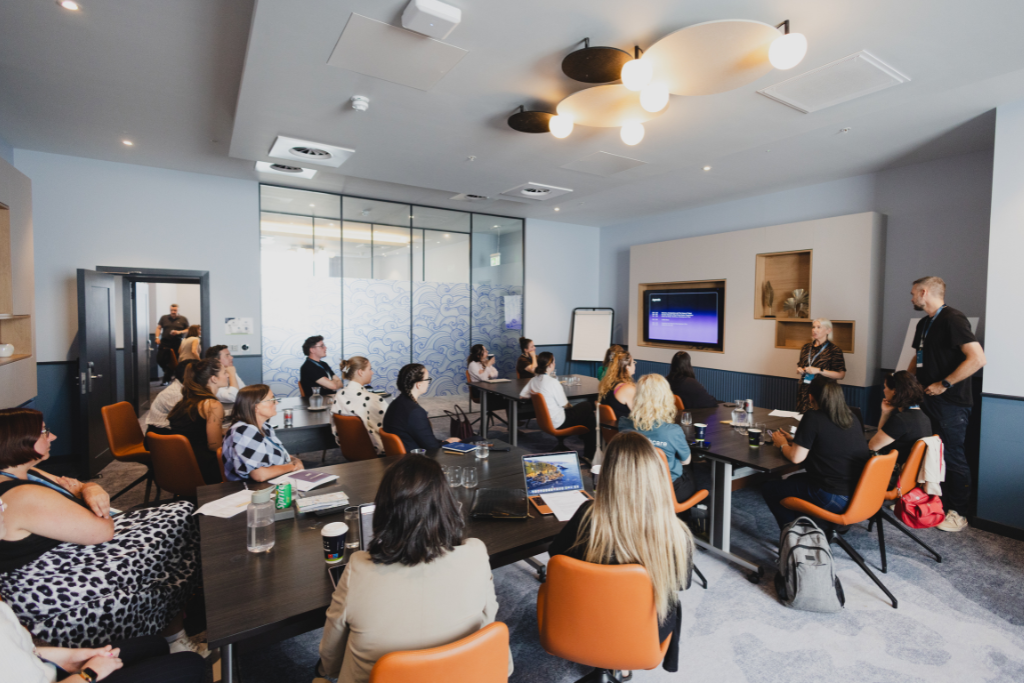
I always try to keep them concise. If you give a workshop creator less time, they will cut to the chase. If you give them more time, they will provide more context and background. So you have to work hard to connect people to the stage and the content, and to get them involved in new ways. We work hard to make sure the 45 minutes cut to the chase rather than include too much background information. Then you have techniques, such as training presenters to spot people in the audience they know to start with during Q&A.
Q5: Looking ahead to the future of healthcare events, are there any significant changes you predict over the next five years?
The thing that underpins healthcare always is that it is vastly different to, say, Red Bull. Red Bull chooses whether an event has strategic value to them. Some organisations see it as a revenue-generating matter. But healthcare requires you to educate healthcare professionals. And if you don’t, then as a pharmaceutical company, you’re not going to drive adoption, deliver your launch, or achieve patient benefit.
Healthcare meetings are generally more resilient than many other sectors because education, evidence exchange and medicine development continue regardless of wider economic cycles.
Now, what’s the big change? The big change will be AI, because most planning is workflow-based and process-based. These processes are open to being altered by AI and large language models. We will see this heavy administrative burden adapt. The pace of change should be very fast.
Q6: How do healthcare events leave a legacy behind?
We need to ask ourselves whether attendees here will bring a group back to this venue. Will they consider Brighton? An event like this brings key healthcare credentials to a destination. Then the destination can use them to attract large-scale events that have a massive ripple effect commercially and socially. To boot, if you bring a bunch of people to a city like Brighton, there’s a very good chance they may consider coming back privately, and there’s that ripple effect as well.
Q7: Is there any city or venue in the UK or globally that is excelling in regeneration?
In the United Kingdom, I think of Aberdeen and the Aberdeen Convention Centre, which was built into the moorland, has a contemporary aesthetic, and is highly sustainability-driven. What I like about meetings and events is that, very rarely, you have a new build that does not incorporate regeneration concepts. Meetings and events can have a significant commercial impact on a city and a destination, and any investment to encourage that, particularly around hub cities, generally comes with sustainability attached. They generally build with that in mind.
Q8: Why is education so important for M&I?
It is hard to be at the office, stop working, and be somewhere else. If you are out of the office for three days, that is probably about two per cent of your working time. That may sound small, but it needs to be justified. If you are not maintaining this kind of routine, it can become complex. So there has to be a full value set in terms of travelling out of your office for three days to do something. Workshops, education, networking, and the city getting involved are about justifying the two per cent, even though it may sound like a small number. I think M&I does a fantastic job at education, and that is why it has gained a loyal circle of attendees who can justify participating in such events.
Explore more about 3Sixty Event Consulting here.