
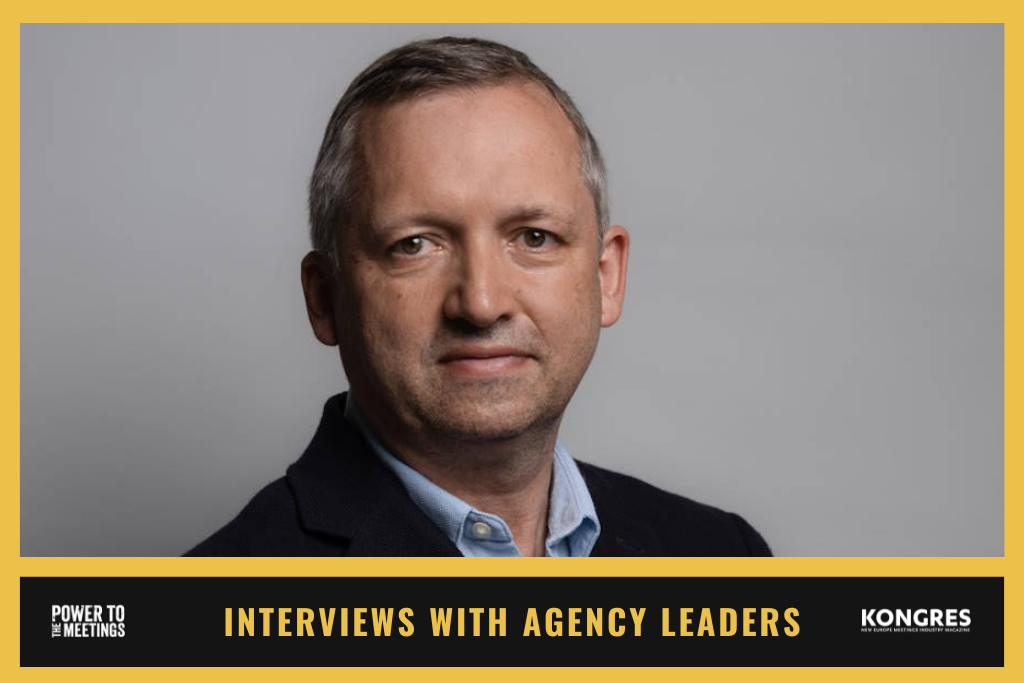
Q1: The Top 100 European event agency leaders list has provided a who’s who of the events industry for the first time. How do you see this recognition, and what does it mean for your agency?
Being included in a list like this is genuinely meaningful, but I see it above all as recognition of a collective effort rather than an individual one. In an industry where you are only as good as your last project, this reflects years of work by the entire UP Partner team, not just my own. For the agency, it means three things. First, it validates our positioning at the intersection of strategy, creativity and operational execution — the market is telling us it sees us as more than a production vendor. Second, it raises the bar: once you appear on a “Top 100” list, clients and partners expect sharper thinking and bolder creativity, and that pressure is healthy.
Third, and this matters to me personally as someone leading an agency outside the traditional London–Paris–Berlin–Amsterdam axis, it gives visibility to the idea that high-impact European work can be conceived and delivered from markets like Portugal that have historically been treated as peripheral. The recognition itself is a nice snapshot, but its real value is in the trust it builds with clients and the motivation it gives our team to keep raising our own standard.
Q2: Live events seem to be the buzzword of 2026. With the industry going from strength to strength, how do you see the future of events?
As long as the human race does not disappear, then events will always exist, I guess.
The future is an orchestrated experience that blends live, digital and on-demand touchpoints along a single participant journey, with technology working invisibly in the background so the foreground can be devoted entirely to human connection.
A few trends feel clear to me. Companies will hold fewer but more meaningful physical gatherings, driven by cost and sustainability pressure, which means every in-person moment will need to justify its strategic weight.
Events themselves are stretching in time — weeks of content seeding before, an intense one or two days live, then months of repurposed content and community follow-up — so agencies that think in campaigns rather than single dates will win. Data will help us design smarter formats and agendas without killing spontaneity, and audiences will increasingly expect a degree of personalisation, in networking, content and pacing, even at events with thousands of attendees. Ultimately, the hunger for live experience has never been stronger, because no screen fully replaces the energy of people sharing a physical moment — the future of events is strategic, measurable, and hybrid by design, but above all will always be people-to-people, no matter the tools you use along the path.
So I have a BIG SMILE when I think about the future of our industry, because humans will always need to gather together to share emotions and live experiences.
Q3: How are economic and political turmoil, rising production costs and ambitious client expectations affecting your agency’s business model?
These pressures are forcing us to be more transparent, more strategic and more selective. On transparency, production costs — venues, technical production, logistics, suppliers — have risen sharply, so we now open the books earlier with clients, showing exactly where money goes and where we can optimise without damaging the experience; this builds trust and speeds up decisions.
On strategy, when budgets tighten, but expectations stay high, our job becomes challenging the brief itself: what is the real objective, which audience actually matters, and where does this event sit in the broader business strategy? Sharpening the “why” often lets us simplify the “how,” sometimes reducing scale while increasing impact, and we back that up with data that proves return on investment rather than relying on impression alone.
On selectivity, we increasingly favour clients who treat us as long-term partners rather than an annual commodity to be re-tendered on price, because recurring relationships let us build reusable frameworks, negotiate better with suppliers, and evolve creative work intelligently over time. We have also diversified beyond full 360-degree production into strategic consulting and content and motion design, which makes the business more resilient in volatile years.
Q4: Artificial intelligence is rapidly reshaping creative and operational processes. To what extent have you integrated it across your processes, and which jobs remain out of its reach?
We have integrated AI platforms fairly deeply, but under one rule: AI accelerates, humans decide. In concept development, it helps generate alternative angles and moodboard directions quickly, though the final creative direction is always human-curated. In content and communication, it drafts first versions of invitations, scripts, and run-of-show narratives and event guides, freeing our team to focus on refinement and storytelling.
Operationally, it supports attendance forecasting, room-layout and flow optimisation, and scheduling; after the event, it helps us turn survey and engagement data into clearer, more actionable client reporting.
But some things remain entirely out of its reach. AI cannot read a room, sense that a client is nervous about something they haven’t said aloud, or build the kind of trust that makes a client hand you their most important annual event and say, “I know you’ll take care of it.” True creative judgment — knowing whether an idea is right for a specific brand, culture and moment — along with on-site leadership under pressure and the day-to-day work of motivating teams and suppliers, are irreducibly human. AI will keep reshaping how we work, but the core of our value — judgment, empathy, leadership and taste — is not going anywhere. Also, no one speaks much about the “elephant in the room”: from the sustainability side, AI is a huge worldwide energy consumer, creating big challenges for humanity if we continue to expand its use at this rate.
Q5: Sustainability has become both a strategic responsibility and a measurable business criterion. How is your agency translating environmental commitments into concrete results and accountability?
We treat sustainability as a design constraint from day one, not an afterthought bolted on at the end. Every project starts with a checklist covering venue and travel choices, material use (modular, reusable, recyclable structures rather than single-use builds), energy sources, and locally sourced food and beverage, with motion content instead of printed materials. We are moving toward genuine circular-economy practice: prioritising rented or upcycled materials, pursuing zero-waste catering policies, and using dedicated software to track carbon footprint and waste diversion phase by phase. For larger events, we provide clients with a baseline of what a comparable event used to look like, what we actually achieved, and where we can improve next time.
As a result, we have been Gold in Ecovadis for 3 years in a row, placing us in the top 5% of event agencies that achieve this score. We are not perfect, but we are moving from symbolic gestures to systematic, transparent accountability, not forgetting that, in the end, sustainability comes at a higher cost, and clients and the market still often choose the green way by option, not because it is mandatory as it should be if we analyse climate change and the consequent risks that it represents fornts.
Q6: How does your event agency attract and retain young talent?
Young professionals today are looking for meaning, growth and respect for their life outside work, and we try to answer all three honestly rather than with slogans. We offer 25 days instead of the normal 22 holiday days. We also have a free day on anniversary dates, and we have a pet grief day when our mascots die. Apart from that, we privilege remote work; we only gather the teams one day each week in the office. On growth, we invest in training in project management, creativity, and digital tools; pair juniors with senior mentors; and rotate people across content, production, and client service so they become well-rounded professionals rather than narrow task-executors.
As part of our European network, 27Names also lets young people connect with associated agencies in other countries and collaborate on international projects. To attract young talent, agencies must have purpose and values side by side in areas like sustainability commitments, inclusion practices, and the kind of clients we choose to work with—and that alignment is as much a retention tool as salary or title.
Q7: If you could enter a time machine, what would you advise yourself when you first started in the events industry?
A good question this one. My advice is: protect your energy early, and worry less about controlling every variable and more about staying calm and present when things inevitably go wrong — rested people make better decisions, burnout kills creativity and leadership, and a sustainable pace is a genuine competitive advantage over a long career. Invest deliberately in relationships, not only in projects, and treat every failure as one of the most useful learning tools you have. This is a small, human industry — clients, suppliers and colleagues cross your path again in new roles for years — and your reputation for how you behave under pressure travels faster than any single case study you can point to.
Q8: If you had to single out one event from your portfolio, which would it be and why?
The next one that is going to happen. I never look much into the past of the events we made. Not that I am not proud of them, but what fuels my will to keep doing this is always the expectation of what’s coming next. So, will you be our next story?
Q9: Which industry buzzword would you permanently ban, and what uncomfortable truth should event agencies start discussing instead?
If I could permanently retire one word, it would be “immersive” — or its cousin “seamless ” — both have been stretched to cover almost anything, from a genuinely transformative environment to a couple of LED screens and some AR bolted onto shallow content. Retiring the word matters less than confronting what it hides.
One uncomfortable truth is that many events are still designed around the organiser’s ego rather than the participant’s real needs—we should ask whether an agenda item exists because it is politically convenient rather than because it adds value. A second, closely related truth is the chronic undervaluation of the strategic and creative thinking behind an event: clients will often pay generously for a spectacular production but hesitate to pay for the thinking that made it spectacular, and until we address that imbalance, we will keep underinvesting in the talent that actually drives value.
And a third truth the industry avoids is its own culture of burnout — wearing exhaustion as a badge of honour is not sustainable, and we need honest conversations about realistic timelines and fair compensation for the people who make these experiences happen.
Q10: Does Europe genuinely operate as one event market, or do outdated divisions between established Western markets and “New Europe” still influence budgets, visibility and access to opportunities?
It is not a true one-event market. Europe operates as one market on paper, but not yet fully in practice. The old divisions have softened, but they have not disappeared. A comparable event in London or Paris still often carries a different perceived “value” than the same quality of work delivered from Lisbon, Warsaw, or Bucharest, and daily rates, fee expectations, and investment levels are still shaped by these old mental maps. Agencies based in Western hubs benefit from proximity to global headquarters, media and established industry networks.
Europe is not yet a market where the best idea wins regardless of postcode.
In contrast, agencies from “New Europe” or Southern Europe often have to work harder to be invited to pitch for pan-European mandates, even when their execution capability is equal or superior. That said, the trend line is genuinely positive: clients are becoming more location-agnostic as long as quality, creativity and reliability are there; talent is more mobile and remote collaboration is now normal; and Lisbon in particular has benefited from its rise as a tech and start-up hub, which has raised the international profile of Portuguese agencies. Speaking as someone leading an agency here, we have learned to turn this into a strength — offering Western-European standards of quality with a more flexible mindset and often a more competitive cost structure. Europe is not yet a market where the best idea wins regardless of postcode, but it is moving in that direction, and recognitions like this Top 100 list are a step toward dissolving those historical borders for good.
Learn more about events organised by UPPartner here.